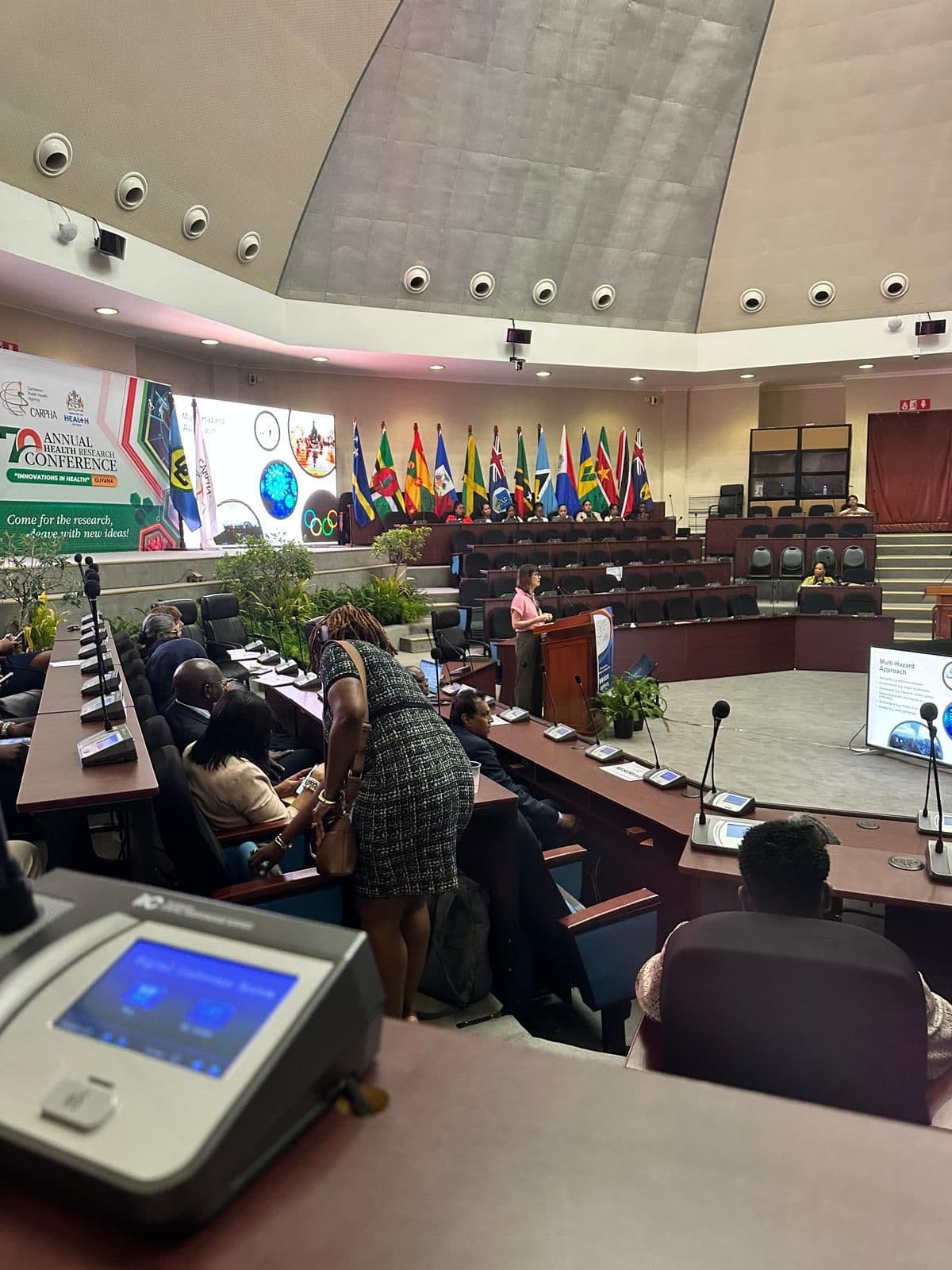
Our founder attended the 70th Annual CARPHA Health Research Conference in Guyana this April. Here is what stood out — including what wasn't on the programme.
The Caribbean Public Health Agency's annual health research conference turned seventy this year. The series began in 1956, which makes it, in CARPHA's own description, "the largest health research conference in the English-speaking Caribbean and the longest-running health research Conference in Latin America and the Caribbean region." That is not a small claim, and on the evidence of our time at the Arthur Chung Conference Centre in Liliendaal, it holds up.
The numbers, as reported by Kaieteur News: around 500 delegates from more than twenty countries. Two hundred and eleven papers submitted, 196 accepted for presentation — 118 oral abstracts and 78 posters, all published in the West Indian Medical Journal. Twelve feature speakers, including researchers from Oxford, Harvard, Imperial, McMaster, University College London and the UK Health Security Agency alongside regional colleagues. The theme was Innovations in Health.
We attended as delegates, not presenters. The purpose was to listen.
The chronic disease programme was serious
Four of the concurrent session tracks were given over entirely to non-communicable disease — sessions 9b, 10b, 11b and 12b — alongside a dedicated nutrition track and a feature lecture from Professor Sonia Anand of McMaster University: Prevention of Chronic Diseases among women in CARICOM: What can we learn from the SmartHealth Cluster RCT.
The abstracts themselves are worth reading rather than summarising. A sample of what was presented:
- Trends in hypertension prevalence, awareness, treatment and control in Jamaica
- Cardiovascular disease risk prediction and cardiovascular mortality in Barbados
- Differences in body and muscle composition by diabetes status among Tobagonian men
- The effects of metal mixtures on blood pressure and hypertension in adults from Tobago
- Prevalence of overweight, obesity and associated risk factors in Barbadian primary school children
- Trends in diabetic ketoacidosis in Guyana: a two-year review of clinical profiles and outcomes
- Early life social factors associated with mortality in Jamaicans with Sickle Cell Disease
- Development of a Cancer dashboard for cancer registries in the English-speaking Caribbean
This is not a region that lacks investigators, lacks epidemiological rigour, or lacks interest in the diseases that are killing its population. Anyone still carrying the assumption that Caribbean research capacity is thin should spend three days in a room with these people.
The gap
Here is the observation we came away with, and we offer it as a genuine question rather than a criticism of a conference that was excellent at what it set out to do.
Across 196 accepted papers, ten concurrent session tracks and twelve feature lectures, no dedicated clinical trials track, session or symposium appeared in the published programme. Every concurrent session is titled by disease area or population: infectious diseases, non-communicable diseases, women's health, mental health, family health, nutrition, public health.
Interventional research was present — but as isolated items rather than as a stream. Professor Anand's feature lecture drew on the SmartHealth cluster randomised controlled trial. One oral abstract reported a randomised clinical trial of management strategies for late pregnancy loss, run at Georgetown Public Hospital Corporation — a Guyanese RCT, presented in a family health session. Dr Moti Ramgopal, who gave the HIV feature lecture, practises at a dedicated US clinical trials site. Professor Chas Bountra of Oxford spoke on translational medicine and Dr Niven Narain of BPGBIO on precision medicine and AI, both a step upstream.
That distribution is the point. Trials turn up at this conference the way they turn up in the region: individually, on the initiative of particular investigators, rather than as an organised sector with its own track, its own methodological conversation and its own commercial infrastructure.
The Caribbean produces first-rate observational and public health research, and it is plainly capable of running randomised studies. What it does not yet do at scale is host industry-sponsored interventional research: the Phase II and Phase III studies that determine which medicines get approved, on what evidence, and in which populations.
That matters more than it might sound. Cardiometabolic disease in this region sits at the extreme end of the global distribution. A sponsor developing a weight-management or cardiovascular outcomes therapy is making decisions right now about where to run it, and the Caribbean is largely not in that conversation — despite carrying some of the world's heaviest disease burden and being systematically under-represented in the pivotal trials that define standard of care.
Guyana's Minister of Health, Dr Frank Anthony, put the underlying principle better than we could in his opening remarks:
"The ultimate goal of research is not publication alone, it is impact. It is better health outcomes, a stronger health system, and longer, healthier lives for our people."
And President Irfaan Ali, announcing a US$30 million science and technology education facility during the conference, framed the constraint precisely:
"The problem is no longer a lack of ideas; it is a shortage of systems that can absorb, govern, finance and scale those ideas fairly."
That is the right diagnosis, and it applies squarely to clinical research. The ideas, the investigators and the patient populations are all present. What is thin is the connective infrastructure — the site networks, the regulatory pathways, the sponsor relationships and the operational track record that turn a research-capable region into a research-delivering one.
What we took away
Three things.
First, the investigator base is real. Any sponsor being told that Caribbean sites mean building from nothing is being told something false. The people are here, they are internationally trained, and a meaningful share of them have been publishing peer-reviewed work for decades.
Second, the regulatory picture is genuinely uneven and nobody is pretending otherwise. CARPHA's Caribbean Regulatory System does real work on medicines assessment and pharmacovigilance, but it does not authorise clinical trials — that stays with individual member states, and the maturity of those national pathways varies enormously across CARICOM. This is solvable, but only by people who have mapped it territory by territory rather than assuming a regional shortcut exists.
Third, the window on some of this is closing. Access to newer obesity pharmacotherapy across the region remains limited, which makes Caribbean populations unusually valuable for medication-naive comparative work. That will not stay true indefinitely, and the region has an interest in participating in the research while it still has something distinctive to contribute to it.
Seventy years is a long institutional memory. The question the region now faces is not whether it can do research — that was answered decisively in Georgetown. It is whether the world's clinical development programmes will show up to use it.
Sources
- 70th Annual CARPHA Health Research Conference, 22–24 April 2026, Arthur Chung Conference Centre, Liliendaal, Guyana — conference.carpha.org
- Conference programme and abstracts, published in the West Indian Medical Journal — CARPHA 2026 conference proceedings
- Delegate, country and paper figures — Kaieteur News, 23 April 2026
- Dr Frank Anthony's opening remarks — HGPTV
- Conference launch and background — Stabroek News, 21 December 2025